



My first freelance project, on the side while I still had a day job, was a set of drawings for a small manufacturer. I quoted $25 an hour, because it was a bit more than I earned as an employee and it felt generous. I worked fourteen evenings, invoiced my hours and congratulated myself. At tax time I discovered that I had paid roughly the same percentage of that income to the pension plan as I had as an employee twice, that I had no paid vacation, no benefits, no software budget and no sick days, and that between chasing the client, revising drawings and waiting to be paid, I had actually billed about two thirds of the hours I had worked. The “generous” rate was, in real terms, a pay cut.
That is the lesson of this guide. A contract rate is not a salary rate with a number added. It has to carry things that an employer normally pays for you, and it has to be earned in far fewer billable hours than a salary year contains.
I will be honest about what I can and cannot give you. There is no official statistical source for freelance or contract CAD rates in Canada. Job Bank, Statistics Canada and the provincial surveys publish employee wages, not what independent drafters charge. Anyone who gives you “the going rate” is quoting a sample of ads, not a measurement. What I can give you instead is something more useful: a transparent model that turns the official employee wage for your job into the rate you need, with the real 2026 numbers for the parts that are fixed by law, and clearly labelled assumptions for the rest. You can then replace my assumptions with your own.
The Short Answer
Using Job Bank’s provincial medians for drafting technologists and technicians as the employee reference, and the model in this guide, a drafter who wants to match the median employee’s total economic position needs to charge roughly $52 to $79 an hour, depending on province and on how many hours a year they can actually bill:
| Province | Employee median (annual at 2,080 h) | Required yearly revenue | Rate at 1,200 billable hours | Rate at 1,400 billable hours | Rate at 1,600 billable hours | Rate at 1,400 h as a multiple of the employee wage |
|---|---|---|---|---|---|---|
| Ontario | $31.25 ($65,000) | $83,159 | $69 | $59 | $52 | 1.90 × |
| British Columbia | $33.65 ($69,992) | $88,947 | $74 | $64 | $56 | 1.89 × |
| Alberta | $36.00 ($74,880) | $94,598 | $79 | $68 | $59 | 1.88 × |
Break-even model. Employee medians from Job Bank (drafting technologists and technicians, November 2025 release). The assumptions are listed below. Not market evidence.
The key ideas:
- Rate = what you need to earn ÷ hours you can bill. Most freelancers bill far fewer hours than an employee is paid for.
- At 1,400 billable hours a year, the required rate is about 1.9 times the employee wage.
- Your results depend mainly on two numbers you control: your utilization (how many hours you actually bill) and your business costs.
- The figures are a break-even model, not market evidence. The market may pay more or less, depending on your specialty, your client and the urgency of the work.
The employee medians come from the Job Bank release updated on November 19, 2025 (reflecting 2023–2024). The 2026 Canada Pension Plan rates are from Canada.ca. For how Job Bank’s wage data is built, see CAD, BIM and Drafting Salaries in Canada: The Complete 2026 Data Guide.
Why a Contract Rate Looks So High
When a client hears “$60 an hour” for a drafter whose employee equivalent earns $31, the reaction is often surprise. The explanation is that the freelance rate has to pay for four things that an employee’s wage does not.
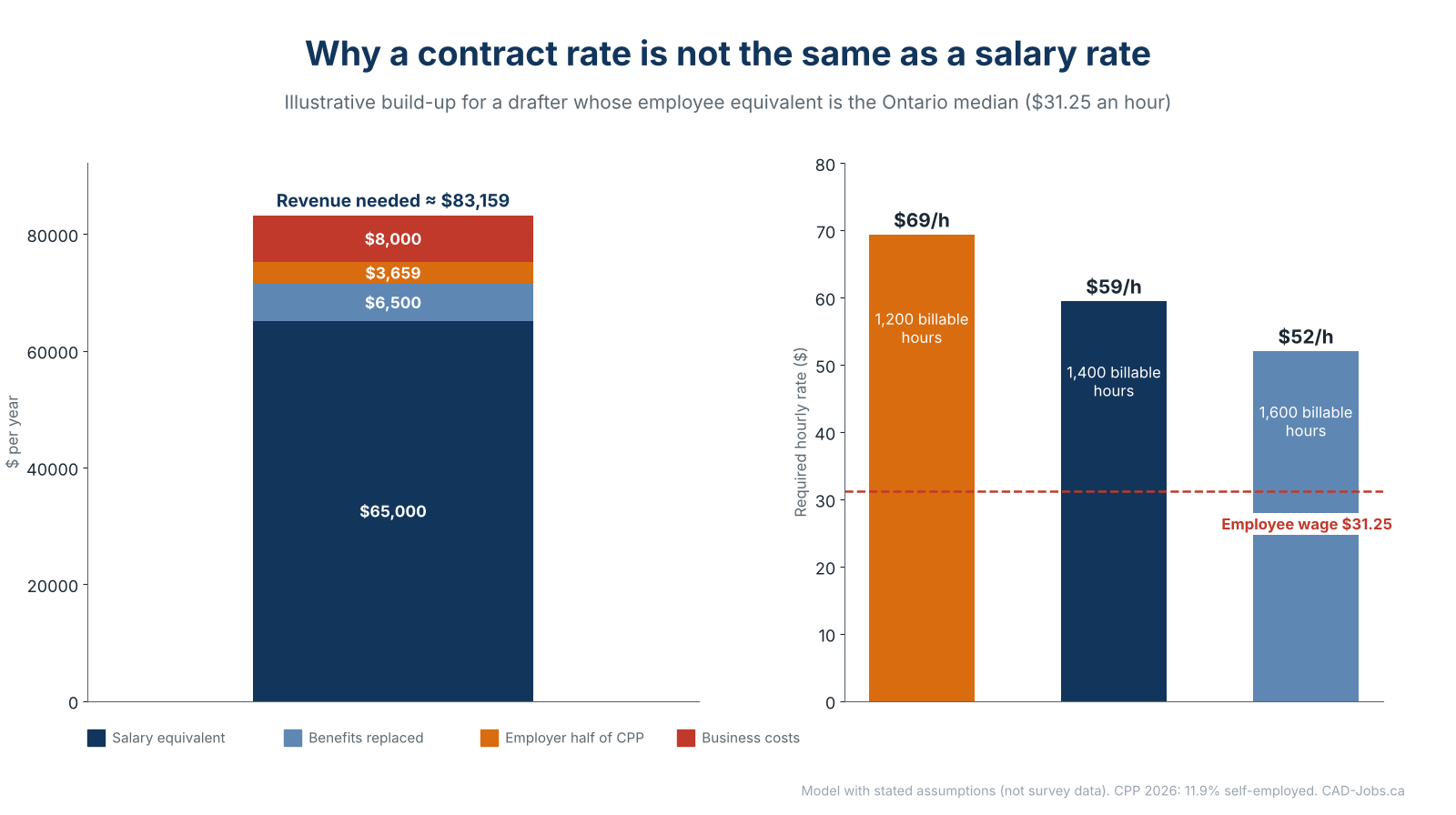
1. The employee-equivalent income
The starting point is what you would earn in a comparable job. For the Ontario median drafter, that is $31.25 an hour, which is $65,000 a year at 2,080 hours.
2. Benefits you now pay yourself
An employee’s wage does not include the benefits the employer provides: group health and dental, pension or RRSP matching, paid sick days and often training. Job Bank reports that 93.7% of drafting technologists and technicians receive at least one non-wage benefit. As a freelancer, you replace them from your own revenue. In my model I assume 10% of the employee-equivalent income, which is deliberately simple. Your real cost depends on your family, your health plan and whether you are already covered by a partner.
3. The employer half of the Canada Pension Plan
An employee pays 5.95% of pensionable earnings into the CPP, and the employer pays the same again. When you are self-employed, you pay both halves. For 2026 the rules are:
- The combined self-employed rate is 11.9% on net self-employment earnings above a basic exemption of $3,500, up to the year’s maximum pensionable earnings of $74,600.
- The maximum base contribution for a self-employed person is $8,460.90.
- Above $74,600 and up to $85,000, a second tier (CPP2) applies at 8% for self-employed people, with a maximum of $832.
In the model I add only the employer half (5.95%), because the employee half is already part of the comparison. In practice, you will see the full 11.9% on your tax return, and you must plan for it.
4. Business costs
Software, a capable computer, backup, insurance, an accountant, a phone, marketing and some training. In the model I assume $8,000 a year. Your real number can be lower if you already own the tools, or higher if you buy annual licences for several programs. Professional liability insurance and software subscriptions are the items that surprise new freelancers most.
The Hidden Number: Billable Hours
An employee is paid for roughly 2,080 hours a year, including paid vacation and statutory holidays. A freelancer is paid only for the hours worked and invoiced.
Start with the 2,080 hours in a full-time year, and subtract what you will not work and bill:
- Vacation. Three weeks is 120 hours.
- Statutory holidays. Around ten days, or 80 hours.
- Sickness, training and unplanned time off. Perhaps 40 hours.
That leaves about 1,840 hours you could work. Now subtract the time you must spend on things clients do not pay for: finding work, quoting, invoicing, bookkeeping, software updates, chasing payments and waiting between projects. If a quarter of your available time goes there, you have about 1,380 billable hours.
That is why I use 1,200, 1,400 and 1,600 in the model:
- 1,200 billable hours: a new freelancer, or one with irregular work.
- 1,400 billable hours: a stable, part-referral practice.
- 1,600 billable hours: an established freelancer with a few steady clients. It requires discipline and a full pipeline.
If your real number is lower than you expect, your rate must go up, or your income goes down. There is no third option.
The Model in Detail
Here are the assumptions behind the table.
| Item | Assumption | Source |
|---|---|---|
| Employee-equivalent income | Job Bank provincial median × 2,080 hours | Official data |
| Benefits you replace yourself | 10% of the employee-equivalent income | My assumption |
| Employer half of CPP | 5.95% of income above the $3,500 basic exemption, capped at $4,230.45 (2026) | Canada.ca, 2026 figures |
| Business costs | $8,000 a year (software, computer, insurance, accounting, other) | My assumption |
| Billable hours | 1,200, 1,400 or 1,600 a year | My assumption |
| Income tax | Not included | Applies to employees and freelancers alike |
The formula is simple:
Required revenue = employee-equivalent income + replaced benefits + employer half of CPP + business costs
Required hourly rate = required revenue ÷ billable hours
You can adjust each piece. If your spouse’s plan covers your family, reduce the benefits line. If you already own your software and computer, reduce business costs. If you plan to keep a day job and freelance part-time, the arithmetic changes again, because your employer already pays your CPP, benefits and some of your costs on the first income.
Two warnings about the model. First, it is a break-even calculation: it tells you what you need to charge to be as well off as the median employee. If you want to earn more than an employee, which is reasonable for taking the risk, you need to charge more. Second, it ignores income tax, which applies to both an employee and a freelancer, though the rules differ. A freelancer can deduct legitimate business expenses. Speak to an accountant.
What Clients Will Actually Pay
I have said that there is no official statistic. In practice, what clients pay depends on factors that the model does not capture:
- Specialty. Civil design, structural detailing, mechanical design with engineering input and BIM coordination are priced higher than general drafting. See the job-family differences in Which CAD Skills, Software and Certifications Pay More in Canada?
- Urgency. A rush job is worth a premium. I would never take a same-day deadline at a standard rate.
- Client type. Engineering firms that need overflow capacity pay differently from homeowners or small contractors.
- Risk and responsibility. If your work will be stamped or relied upon, you carry liability.
- Your track record. A documented history of accurate, on-time work is the strongest argument for a higher rate.
- Region. Provincial wage differences carry through. In provinces with higher employee wages, rates tend to follow. See CAD Salaries by Province: Ontario, Québec, BC, Alberta and More Compared.
How to find real market evidence. Ask three or four peers what they charge. Look at the rates posted on contract job ads, which are increasingly visible in provinces with pay transparency rules. Compare quotes you receive. And treat any number you find online as one data point, not a standard.
Pricing Models: Hourly, Per Drawing, Fixed Price, Retainer
How you charge matters as much as how much.
Hourly. Simple, fair when the scope is unclear, and the safest for beginners. The downside is that faster work earns you less, and clients may question every hour.
Per drawing or per sheet. Common in drafting and detailing. It rewards speed and standardization. It only works if the drawing types are well defined. Specify what is included and what counts as a revision.
Fixed price for a project. Good when you can estimate the work accurately and control the scope. Dangerous if the scope is vague. Always define deliverables, number of revision rounds and what triggers a change order.
Retainer. A monthly fee for a set number of hours, usually for a client who needs ongoing capacity. It stabilizes your income and reduces your search time.
My advice for a new freelancer: start hourly or with a clearly scoped fixed price, track your real time on every job for a year and then decide whether per-drawing or retainer pricing suits your work.
Terms That Protect Your Rate
A good rate is worthless if the terms undo it. Put these in writing, in a simple agreement or purchase order.
- Scope and deliverables. What exactly will you produce, in which format and by when?
- Revisions. How many rounds are included, and what happens after?
- Change orders. A rule that new work is priced separately.
- Minimum engagement. A minimum charge for small jobs, which is where the time goes.
- Payment terms. Net 30 is common. For new clients, ask for a deposit.
- Late payment. State a consequence.
- Rush premium. Say what applies to short deadlines.
- Ownership and use of drawings. Who owns the files, and can you show them in your portfolio?
- Confidentiality. Many clients will ask for it, and you should be clear about what you can disclose.
- Insurance and liability. Know whether you need professional liability coverage and what the client requires.
Taxes and Registration: The Basics
This is general information, not tax or legal advice. Rules change and individual situations differ, so speak to an accountant.
- CPP. As a self-employed person you pay both halves, as shown above.
- GST/HST. In Canada, a small supplier whose revenue stays below $30,000 over four consecutive calendar quarters does not have to register. Above that threshold, you must register and collect GST/HST (or QST in Québec, plus GST). Many freelancers register earlier, so they can claim input tax credits on business purchases.
- Business structure. Sole proprietorship is the simplest. Incorporation can offer advantages at higher income and costs more to maintain. See Taxes, Invoicing and Business Structure for Freelance Drafters in Canada.
- Employee or contractor? In Canada, the way you work matters more than the label. If the client controls when, where and how you work, supplies your tools and treats you like staff, the Canada Revenue Agency may consider you an employee, whatever the contract says. If you have a single client who treats you as staff, discuss this with an accountant. It matters for both of you.
- Québec. Québec has its own pension and parental insurance plans, so the contribution rules and rates differ from those in this guide.
Freelance, Contract or Permanent: Which One Is for You?
The rate is only one side. A freelancer who earns more but spends a third of their time looking for work, carries all the risk and has no benefits may be worse off than a well-paid employee. A permanent job offers stability, benefits and growth, but less flexibility and, usually, a lower hourly rate. A fixed-term contract is a middle path.
If you are considering the move, read How to Become a Freelance CAD Drafter in Canada: Clients, Rates, Taxes and Tools and Freelance vs Contract vs Permanent CAD Jobs: The Complete Comparison. For the remote and hybrid side, Remote, Hybrid and Contract CAD Jobs in Canada: The Complete Guide.
If you are an employer weighing contractors against staff, In-House vs Outsourced vs Offshore Drafting: A Decision Guide looks at the other side of the table.
A Step-by-Step Method to Set Your Rate
- Start with the employee reference. Find the Job Bank median for your job family and province.
- Compute the annual equivalent. Median hourly wage × 2,080.
- Estimate your replaced benefits. Be honest about what you actually need.
- Add the employer half of CPP, using the 2026 rules above.
- Add your real business costs.
- Estimate your billable hours. Be conservative.
- Divide. That is your break-even rate.
- Add a margin for risk and for the income you want.
- Test against the market. Compare with peers, postings and quotes.
- Put it in writing, with terms that protect it.
Common Mistakes
- Pricing from your old hourly wage. The most common error, and the most costly.
- Counting 2,080 billable hours. Nobody bills that many.
- Forgetting that CPP is paid twice. It arrives as a surprise on your tax return.
- Not charging for revisions and small jobs. Where the unpaid time hides.
- Competing on price. The cheapest freelancer is not the one who stays in business.
- Working without a written agreement. You are one misunderstanding away from an unpaid invoice.
Frequently Asked Questions
How much do freelance CAD drafters charge in Canada? There is no official statistic. A break-even model based on the Job Bank employee median gives roughly $52 to $79 an hour, depending on province and billable hours. Real rates vary by specialty, client and urgency.
Why is a contract rate so much higher than a salary rate? Because it must replace benefits, the employer half of CPP and business costs, and it is earned over fewer billable hours than a salary year.
How many hours can a freelancer realistically bill? Between about 1,200 and 1,600 hours a year, depending on experience and pipeline.
Do I have to charge GST/HST? Once your revenue exceeds $30,000 over four consecutive calendar quarters, you must register. Many register earlier. Check with an accountant.
Is it better to charge per hour or per drawing? Start hourly or with a clearly scoped fixed price. Per-drawing pricing works when drawing types are standardized.
Should I incorporate? It depends on your income, costs and personal situation. See the tax and structure guide linked above and speak to an accountant.
Sources
- Job Bank: Design and drafting technologist wages (NOC 22212), release of November 19, 2025
- Job Bank: How wages are determined
- Canada.ca: Contributions to the Canada Pension Plan
- Canada.ca: Canada Pension Plan enhancement
- Canada.ca: CPP maximum benefit amounts and related figures, 2026
The model’s assumptions (10% benefits, $8,000 business costs, 1,200 to 1,600 billable hours) are mine and are not survey data. CPP figures are for 2026 and are indexed every year.
Charge what the work is worth, and what the business needs. The market will tell you quickly whether you are close, but only if you know your own numbers first.