



A few years ago a very good designer I knew called me with a decision to make. She had two offers. One paid $72,000. The other paid $68,000. “The first one is obviously better,” she said. Then we spent an hour going through the details together. The $72,000 job was a 40-hour week with an unspoken expectation of “a few extra hours” on deadlines, two weeks of vacation, no group benefits until after a six-month probation and no retirement contribution. The $68,000 job was a 37.5-hour week, three weeks of vacation, health and dental from day one, a 4% retirement match and a training budget. When we converted everything to the same unit, the lower salary was worth more than $7 an hour more for each hour she would actually work.
She took the $68,000 job. Two years later, she was running a small team there.
A job offer is not a number. It is a package of money, time and conditions, and the number on the first line is only one part of it. This guide gives you a method to compare any two offers, or an offer against your current job, in a way that reflects what you will actually earn and what you will actually give up. It also tells you what you should expect to see in a Canadian offer letter, and which legal minimums apply before an employer adds anything of their own.
The Short Answer
To compare offers fairly, convert each to the same unit: total value per hour actually worked.
Total yearly value = base pay + employer-paid benefits + retirement contributions + bonuses you can count on + training and other budgets you will really use
Hours actually worked = (weeks in the year − vacation weeks − paid holidays) × (paid hours per week + unpaid overtime you will really do)
Value per hour worked = total yearly value ÷ hours actually worked
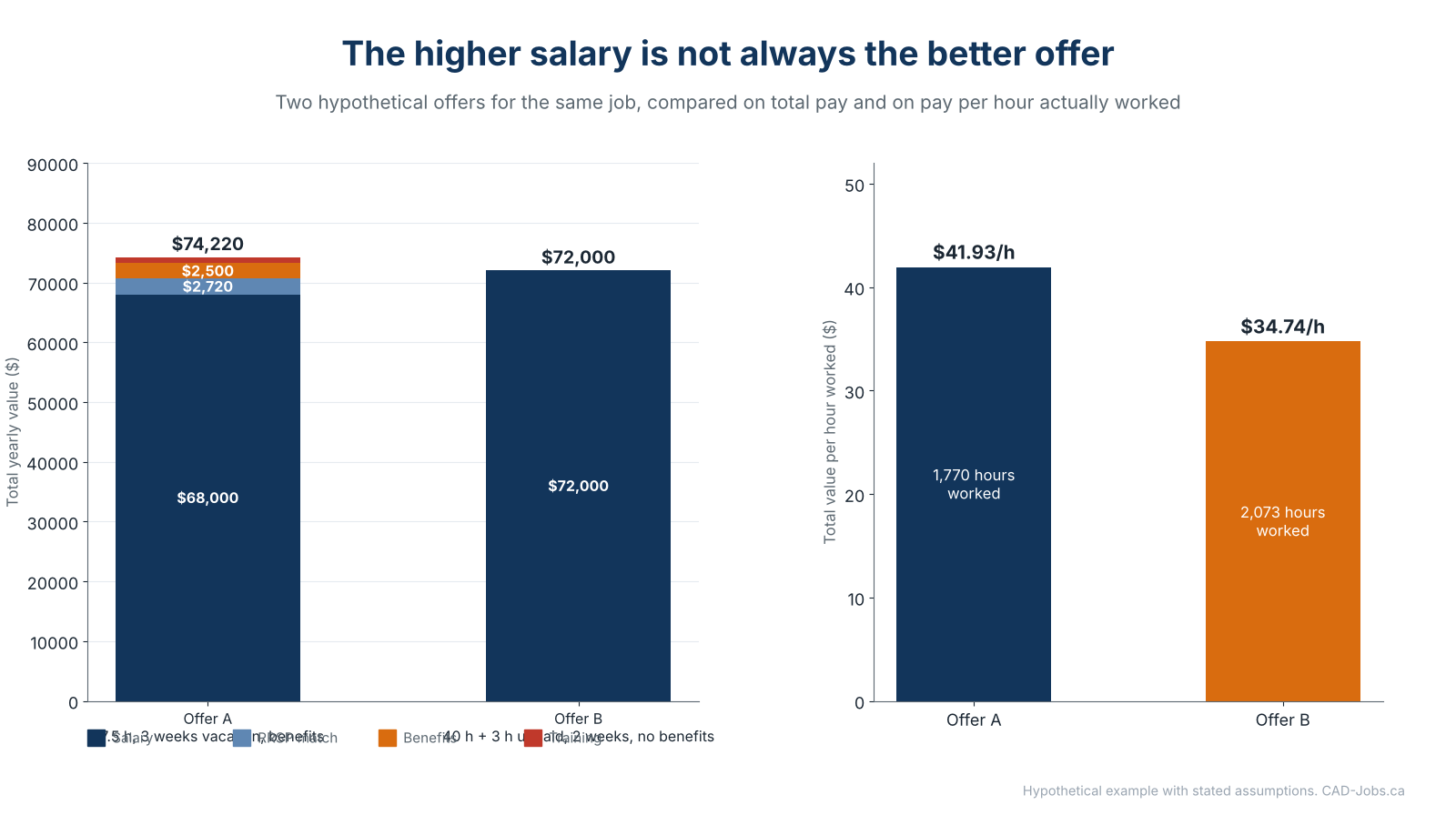
The chart shows a hypothetical example, with assumptions stated below. In it, the offer with the lower salary is worth about $41.93 for each hour worked, against $34.74 for the offer with the higher salary, a gap of roughly $7.19 an hour. The example is not a prediction about any real employer. It shows how quickly the ranking can reverse once you count everything.
Before you do any arithmetic, use the data in CAD, BIM and Drafting Salaries in Canada: The Complete 2026 Data Guide to check that the base pay is in a reasonable range for your occupation and province.
The Parts of an Offer
Here is every element I check, in the order that I check it.
1. Base pay and how it is expressed
- Hourly or salaried? An hourly wage is usually paid for each hour worked, with overtime rules that follow the law. A salary is a fixed amount, and what it assumes about hours matters.
- How many hours does the salary assume? A $65,000 salary on a 37.5-hour week is a higher hourly rate than $65,000 on a 40-hour week, by about 6.7%. Always ask.
- Is it before tax? Yes, always. Do not compare gross to net.
2. Hours and overtime
Overtime is one of the biggest hidden differences. Ask:
- What is the standard work week?
- Is overtime paid, banked as time off, or expected without compensation?
- Is the role classified in a way that exempts it from overtime rules?
- How often do deadlines push hours up in the busy season?
I explain the legal side below.
3. Vacation and holidays
Count the weeks of paid vacation, the paid statutory holidays and any additional paid days, such as a winter closure or a personal day. Each extra week is worth about 2% of your salary.
4. Health, dental and other benefits
Look for:
- Extended health, dental and vision
- Life and disability insurance
- Paid sick days
- Employee assistance program
- When do they start? Many employers make you wait until the end of a probation period.
- Who pays? Fully employer-paid, shared or voluntary.
Job Bank reports that the share of workers who receive at least one non-wage benefit is 93.7% for drafting technologists and technicians, 90.7% for civil engineering technologists, 86.7% for architectural technologists, 94.3% for mechanical engineering technologists and 91.7% for geomatics technicians and analysts. A good employer will usually be at or above that level.
5. Retirement
This is where the largest long-term differences hide.
- Defined-benefit pension. A guaranteed pension in retirement, common in the public sector and some large employers. Extremely valuable.
- Defined-contribution pension. The employer and employee contribute to an account, and the result depends on investments.
- Group RRSP or deferred profit sharing plan with matching. If the employer matches your contribution, that match is part of your pay. Not using it is giving up money.
- No retirement plan. Then your own saving has to do everything.
Ask about the match, the waiting period and any vesting schedule, which is the length of time before the employer’s money becomes yours.
6. Bonus and variable pay
- Is it guaranteed, target-based or discretionary?
- What did people actually receive in the past two years?
- Is it counted in overtime or vacation pay?
Do not count a discretionary bonus at full value. I usually count half, or nothing, until there is a record.
7. Professional development
- Payment of association dues and exam fees
- A training budget, and whether you will actually have time to use it
- Paid time for courses and conferences
- Support toward a technologist designation or a professional licence
8. Flexibility and location
- Hybrid or remote work, and whether it is a right or a favour
- Compressed work weeks
- Commuting time and costs
- Travel to sites or clients and how it is paid
9. Tools
- Software licences you will have access to
- A suitable computer, monitors and home equipment
- Access to specialized tools and training on them
10. Role, title and growth
- Does the title match the work?
- Who will you report to?
- What is the path to the next level, and what does it require?
- Is there a defined review cycle?
A role that pays $3,000 less but gives you ownership of a discipline can be worth much more over five years. For the long view, read From Drafter to Senior Designer to Manager: The CAD Career Progression Guide.
11. The fine print
- Probation. Its length and what changes after it.
- Termination. Notice, and what the contract says about severance. Employment standards set minimum notice, and many provinces give more through common law, so a contract clause that tries to give you less than the legal minimum should be reviewed.
- Non-competition and non-solicitation clauses. Ontario, for example, has restricted non-compete clauses for most employees since 2021. Read what applies in your province.
- Ownership of work and your portfolio. Can you show your drawings and models when you apply to your next job?
- Intellectual property. What the employer owns, and what you do outside work.
- Where the offer is silent. Silence usually favours the employer.
The Legal Minimums You Should Know
Employment standards are set by each province, with the federal government covering federally regulated industries. These rules set the floor under any offer. The table below summarizes widely reported general rules. I took them from public summaries of provincial rules, not from the statutes themselves, so verify them with your province’s employment standards office before you rely on them.
| Jurisdiction | Overtime at 1.5 times pay after | Minimum paid vacation (general rule) |
|---|---|---|
| Ontario | 44 hours a week | 2 weeks (4%) after 12 months; 3 weeks (6%) after 5 years |
| British Columbia | 8 hours a day or 40 hours a week (double time after 12 hours a day) | 2 weeks (4%) after 1 year; 3 weeks (6%) after 5 years |
| Alberta | 8 hours a day or 44 hours a week | 2 weeks (4%) after 1 year; 3 weeks (6%) after 5 years |
| Québec | 40 hours a week | Increases with years of service: check CNESST for the exact entitlement |
| Saskatchewan | 8 hours a day or 40 hours a week | 3 weeks after 1 year; 4 weeks after 10 years |
| Federally regulated employers | 8 hours a day or 40 hours a week | 2 weeks after 1 year; 3 weeks after 5 years; 4 weeks after 10 years |
General rules as reported by public summaries. Exemptions and exceptions exist. Other provinces and territories have their own rules: check your provincial employment standards office.
Three practical points:
- Overtime rules apply to employees covered by the relevant employment standards act, and some categories are exempt, typically managers and supervisors and certain professionals. Exemptions depend on your actual duties, not your title. A “team lead” who spends most of the day drafting is often not exempt. If you are told you are exempt, ask on what basis.
- A salary does not automatically mean “no overtime”. In several provinces, salaried employees still qualify for overtime if they are not in an exempt category.
- Vacation minimums are floors. Many employers in this profession give three weeks from the start, and some give more to experienced hires.
The names of the offices to check are the Ontario Ministry of Labour, the BC Employment Standards Branch, Alberta Employment Standards, Québec’s CNESST and the equivalent office in your province. For other provinces and territories, check your provincial government’s employment standards page.
A Worked Example
Here is the comparison behind the chart. The assumptions are mine and are labelled as such.
| Item | Offer A | Offer B |
|---|---|---|
| Base salary | $68,000 | $72,000 |
| Paid hours per week | 37.5 | 40 |
| Unpaid overtime (average per week) | 0 | 3 |
| Vacation weeks | 3 | 2 |
| Paid statutory holidays (assumed) | about 1.8 weeks | about 1.8 weeks |
| Weeks actually worked | 47.2 | 48.2 |
| Hours actually worked in the year | 1,770 | 2,073 |
| Employer-paid health and dental (assumed) | $2,500 | $0 |
| Retirement match (4% of salary) | $2,720 | $0 |
| Training budget | $1,000 | $0 |
| Total yearly value | $74,220 | $72,000 |
| Value per hour worked | $41.93 | $34.74 |
Hypothetical example. All assumptions are mine.
How the example is built:
- Weeks worked. 52 weeks minus vacation weeks minus about 1.8 weeks of paid statutory holidays. That gives 47.2 weeks for Offer A and 48.2 weeks for Offer B.
- Hours. Offer A is a 37.5-hour week with no unpaid overtime. Offer B is a 40-hour week plus 3 hours of unpaid overtime on average.
- Employer-paid health and dental. I assumed $2,500 a year for Offer A. Offer B has none.
- Retirement match. Offer A matches 4% of salary.
- Training. Offer A includes a $1,000 budget.
The result: Offer A is worth $74,220 for about 1,770 hours worked, or $41.93 per hour. Offer B is worth $72,000 for about 2,073 hours worked, or $34.74 per hour.
You can change every assumption. If you have a partner whose plan covers your family, benefits matter less. If you value a short commute, add a number for it. The point is not that Offer A is always better. It is that you cannot know until you convert both to the same unit.
If you prefer a tool to a spreadsheet, the CAD Job Offer Comparison Calculator does this for you.
Hourly Rate vs Salary: A Quick Conversion
To compare an hourly job with a salaried one, convert to the same basis.
- Hourly to annual: hourly wage × paid hours per week × 52
- Annual to hourly: salary ÷ (paid hours per week × 52)
At a 40-hour week, there are 2,080 paid hours in a year. At 37.5 hours, there are 1,950. I give a conversion table for common wages in CAD Drafter Salary in Canada (2026): By Province, Experience and Industry.
Remember that salaried workers are usually paid for their holidays and vacations, and that many hourly workers are as well. Ask.
Contractor or Employee?
Sometimes an offer arrives as a “contract” at an hourly rate that looks high. Compare it carefully. As a contractor you pay both halves of the CPP (11.9% in 2026 up to $74,600 of earnings after the basic exemption), you provide your own benefits, and you have no paid holidays or vacation. I show the break-even calculation in Freelance and Contract CAD Rates in Canada: The Pricing Guide.
Also ask whether you are truly independent. If you work set hours, at the client’s premises, with the client’s tools, under the client’s supervision, you may in practice be an employee, and a contractor label may remove protections you are entitled to. See Freelance vs Contract vs Permanent CAD Jobs: The Complete Comparison.
Red Flags
I have seen these in offers and in conversations with employers who later regretted them.
- No written offer. If it is not in writing, it is not agreed.
- A salary “commensurate with experience” and no number. In provinces with pay transparency rules, a qualifying public posting should include pay information.
- “Flexible hours” that mean unlimited hours.
- Overtime “expected” but not mentioned in the contract.
- A title that does not match the work, or a scope that grows without pay.
- Benefits “to be discussed” after you accept.
- A very long probation with reduced rights.
- A contractor arrangement for what is clearly an employee’s job.
- Pressure to decide in hours. A good employer gives you time.
- A refusal to put promised items in writing.
None of these alone means you should walk away, but each is a reason to ask a question.
How to Compare Two Offers in 30 Minutes
- Write both offers in one table: base pay, hours, overtime, vacation, holidays, benefits, retirement, bonus, training, flexibility, tools, title, growth, fine print.
- Convert to money wherever you can: add up salary, employer-paid benefits, retirement match and budgets you will really use.
- Estimate hours worked, including unpaid overtime you expect.
- Calculate value per hour worked for each.
- Add the non-money factors: commute, growth, culture, stability, the people you would work with. Score them honestly from 1 to 5.
- Check the base pay against the data. Is it in a reasonable range for your occupation and province? Use the Job Bank figures and the posted ranges.
- Decide, then negotiate the items that matter most. See How to Negotiate a CAD Salary or Raise in Canada: Data, Scripts and Strategy.
Questions to Ask Before You Accept
- Can I have the offer in writing?
- How many hours per week does the salary assume?
- How is overtime handled, and how often is it needed?
- When do benefits start, and what do they cover?
- Is there a retirement plan, and what is the match?
- What is the vacation entitlement in the first year, and how does it grow?
- Is there a training budget, and who approves it?
- What are the probation terms?
- Is the role classified as exempt from overtime, and why?
- What would success look like in the first year, and how is it reviewed?
- Can I show my work in my portfolio?
Frequently Asked Questions
How do I compare a job offer with a higher salary but fewer benefits? Convert both to value per hour worked: salary plus employer-paid benefits plus retirement match plus budgets, divided by the hours you will actually work.
Is a salaried CAD job entitled to overtime? It depends on the province and on whether your duties place you in an exempt category such as manager or certain professional roles. Check your provincial employment standards office.
How much is an extra week of vacation worth? About 2% of your annual salary, because one week is one fifty-second of the year.
Should I count a bonus? Only to the extent that it is guaranteed or has a record. I usually count discretionary bonuses at half value or less.
What benefits should a Canadian employer offer a CAD technician? Job Bank reports that around nine in ten workers in these occupations receive at least one non-wage benefit. Look for extended health and dental, paid vacation and sick days, and a retirement plan or match.
Do I need a lawyer to read an employment contract? Not for a standard offer, but for complex terms (non-compete, intellectual property, severance), a short consultation can be worth it.
Sources
- Job Bank: Design and drafting technologist wages and benefits (NOC 22212)
- Job Bank: Civil engineering technologist wages and benefits (NOC 22300)
- Job Bank: Architectural technologist wages and benefits (NOC 22210)
- Job Bank: Geographic information systems (GIS) analyst wages and benefits (NOC 22214)
- Job Bank: How wages are determined
- Wealth North: Overtime pay rules in Canada (public summary of provincial rules)
- Canada.ca: Contributions to the Canada Pension Plan
Employment standards change and have exceptions. The legal minimums above come from public summaries and should be verified with your province’s employment standards office. The worked example is hypothetical.
An offer is a story about how a company will treat you for the next several years. Read all of it, not only the first line.