

Some of the best designers I ever worked with could not have told you what a “NOC code” was. They could, however, take a vague request such as “we need a bracket that holds this motor, survives vibration and can be made on our existing laser” and turn it, in two days, into a SolidWorks model, a drawing package and a bill of materials that the shop could build without a single phone call. Those designers were paid very differently from one another. Some earned barely more than a senior drafter. Others earned close to what a young engineer made. The software on their screens was identical.
What separated them was not the tool. It was how much of the engineering decision they owned, how well they knew manufacturing, and whether they had positioned themselves in a part of the market that pays for that skill. This is the most important thing to understand if you work in mechanical design and use SolidWorks, Inventor or Fusion: your salary is set by the job you do and the industry you do it in, not by the software on your CV.
In this guide I will give you the official wage data for mechanical design technologists, show the gap to mechanical engineers, explain what the data cannot tell you about SolidWorks specifically, and share how I would reason about your pay, your next step and your negotiation.
The Short Answer
Job Bank’s wage data for mechanical engineering design technologists (NOC 22301) shows:
- Low (10th percentile): $23.08 an hour, about $48,000 a year
- Median: $35.00 an hour, about $72,800 a year
- High (90th percentile): $51.28 an hour, about $106,700 a year
These figures come from the release updated on November 19, 2025 and reflect wages paid in 2023–2024. Annual values assume 2,080 hours, rounded to the nearest $100. For how to read Job Bank’s low, median and high figures, see CAD, BIM and Drafting Salaries in Canada: The Complete 2026 Data Guide.
Compare with the general drafting group (NOC 22212), whose national median is $31.79 an hour. Mechanical design technologists earn about $3.21 more at the median, roughly $6,700 a year. That is the reward the market pays for the engineering content of the work.
Two important notes. First, there is no official wage line for SolidWorks users. No government dataset separates people by software. Second, a “mechanical drafter” whose work is mainly detailing drawings from someone else’s models sits in the general drafting group, not in this one. Where you are depends on what you really do.
Who Is a “Mechanical Designer” in the Data?
Job Bank files mechanical design technologists under NOC 22301, mechanical engineering technologists and technicians. The job title Job Bank uses is mechanical engineering design technologist. People in this group typically:
- Design and develop components, assemblies and equipment, working with engineers or independently
- Build 3D models and produce manufacturing drawings
- Prepare bills of materials, specifications and cost information
- Support prototyping, testing, procurement and manufacturing
- Work with suppliers, machine shops and fabricators
In practice, the same person may be called mechanical designer, design technologist, product designer, machine designer, tooling designer or CAD designer. Match yourself to the data by what you do: if you decide shapes, materials, fits and manufacturing methods, you belong in the design group. If you mainly detail drawings from models others have made, you are closer to the drafting group.
For the full difference between roles, read Mechanical Designer vs Mechanical Drafter vs Mechanical Engineer in Canada.
Mechanical Design Technologist Salaries by Province
Job Bank published the following provincial figures in the same release. Provinces not shown did not have a published figure in the sources I could verify.
| Province | Low (10th pct) | Median | High (90th pct) | Median per year |
|---|---|---|---|---|
| Canada | $23.08 | $35.00 | $51.28 | $72,800 |
| Saskatchewan (est.) | $27.45 | $41.50 | $61.66 | $86,300 |
| Alberta | $18.03 | $39.00 | $65.00 | $81,100 |
| Ontario | $23.00 | $38.00 | $52.88 | $79,000 |
| British Columbia | $23.00 | $37.00 | $79.33 | $77,000 |
| Québec | $24.00 | $35.00 | $48.00 | $72,800 |
| New Brunswick | $25.00 | $35.00 | $43.27 | $72,800 |
(est.) marks figures that come from Statistics Canada’s model-based Small Area Estimation instead of a direct survey count. Annual figures: median × 2,080 hours, rounded to the nearest $100.
What I read in these numbers:
- Saskatchewan ($41.50) and Alberta ($39.00) are at the top. Energy, mining, agricultural equipment and industrial manufacturing keep demand for mechanical design steady.
- Ontario ($38.00) and British Columbia ($37.00) are also well above the national median. Ontario has the largest manufacturing base in the country.
- Québec ($35.00) and New Brunswick ($35.00) are at the national median.
- The ranges are very wide. Alberta runs from $18.03 to $65.00 and British Columbia from $23.00 to $79.33. The highest 10% in these provinces are earning more than $135,000 a year at full-time hours. Those are senior people who carry real design responsibility, often with overtime or project-based premiums.
- Saskatchewan’s figure ($41.50) is a Statistics Canada model-based estimate, so treat it as an indicator.
Regional detail. Job Bank also publishes regional figures for some areas.
| Region | Province | Low (10th pct) | Median | High (90th pct) | Median per year |
|---|---|---|---|---|---|
| Saskatoon–Biggar | SK | $29.36 | $42.33 | $55.44 | $88,000 |
| Red Deer | AB | $28.55 | $41.31 | $62.81 | $85,900 |
| Vancouver Island and Coast | BC | $27.23 | $40.79 | $56.16 | $84,800 |
| Lethbridge–Medicine Hat | AB | $25.76 | $38.36 | $58.70 | $79,800 |
| Hamilton–Niagara Peninsula | ON | $25.11 | $38.82 | $53.44 | $80,700 |
| Toronto Region | ON | $23.00 | $38.00 | $52.88 | $79,000 |
| Northwest Region | ON | $25.43 | $37.60 | $52.93 | $78,200 |
| Ottawa Region | ON | $24.57 | $36.82 | $54.15 | $76,600 |
| Estrie (Sherbrooke) | QC | $25.21 | $35.79 | $50.52 | $74,400 |
| Montréal Region | QC | $24.00 | $35.00 | $51.10 | $72,800 |
| Centre-du-Québec | QC | $24.79 | $34.89 | $45.97 | $72,600 |
| Capitale-Nationale | QC | $26.00 | $34.00 | $51.92 | $70,700 |
| Moncton–Richibucto | NB | $24.04 | $32.72 | $47.13 | $68,100 |
Regional figures come from Job Bank, and several of them are model-based estimates. Annual figures: median × 2,080 hours, rounded to the nearest $100.
Notice that the Saskatoon–Biggar Region ($42.33), the Red Deer Region ($41.31) and Vancouver Island and Coast ($40.79) are above the national figure by $6 to $7 an hour. Local industrial clusters and tight labour markets matter more than the province label.
Designer vs Engineer: How Big Is the Gap?
This is the question I am asked most often by designers in their thirties: “Should I go back and become an engineer?” The data helps you answer it with numbers.
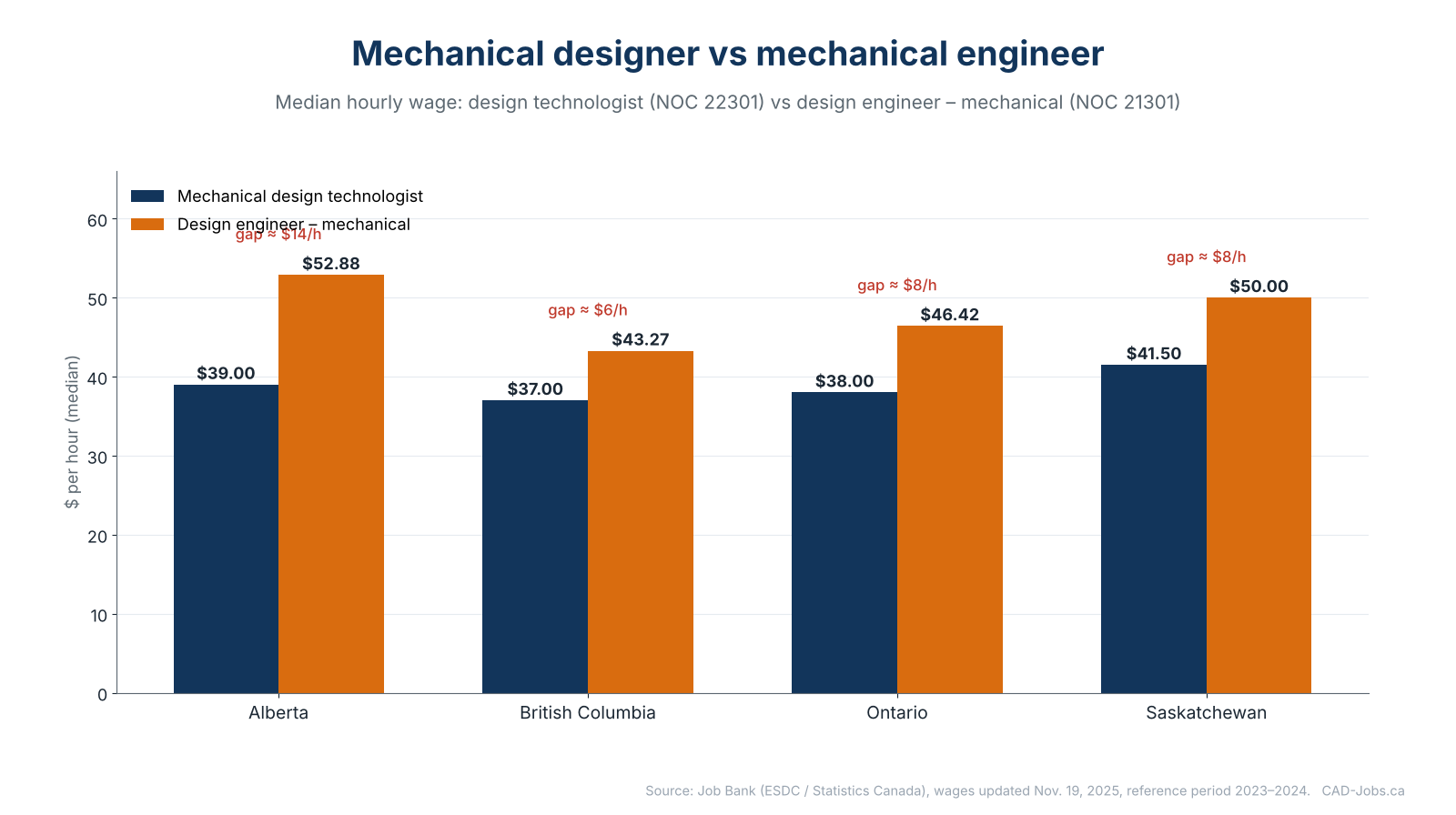
Job Bank publishes wages for design engineer, mechanical, an occupation in the mechanical engineers group. Here is the comparison where both figures are published.
| Province | Mechanical design technologist (median) | Design engineer, mechanical (median) | Gap per hour | Gap per year |
|---|---|---|---|---|
| Alberta | $39.00 | $52.88 | $13.88 | $28,900 |
| British Columbia | $37.00 | $43.27 | $6.27 | $13,000 |
| Ontario | $38.00 | $46.42 | $8.42 | $17,500 |
| Saskatchewan | $41.50 | $50.00 | $8.50 | $17,700 |
Job Bank, release updated November 19, 2025. Gap per year = gap per hour × 2,080 hours, rounded to the nearest $100.
The gap between median wages is large and consistent:
- Alberta: about $13.88 an hour, roughly $28,900 a year
- Saskatchewan: about $8.50 an hour, roughly $17,700 a year
- Ontario: about $8.42 an hour, roughly $17,500 a year
- British Columbia: about $6.27 an hour, roughly $13,000 a year
Annual differences use 2,080 hours.
How I would interpret this. First, the engineer’s premium is real: $13,000 to $29,000 a year at the median, with a much higher ceiling (Alberta’s 90th percentile for design engineers is $96.15 an hour). Second, that premium pays for a degree, a licence and legal responsibility. A professional engineer signs and stamps designs and carries liability. Third, becoming an engineer takes years and money, so the right question is not “is it worth it?” but “is it worth it for me, given my age, family situation and the type of work I want to do?”
For many mechanical designers, the best path is a senior designer or design lead role in the right industry, which can pay close to a junior engineer without the cost of a degree. For others, especially those who want to own the design decision and the stamp, bridging programs make sense. I cover the options in From Technologist to Engineer: Pathways, Bridging Programs and Trade-Offs in Canada.
What the Data Cannot Say About SolidWorks
I need to be blunt: I cannot give you a SolidWorks salary premium, and neither can anyone else with real data. Job Bank, Statistics Canada and the provincial surveys do not break wages down by software. Websites that claim “SolidWorks designers earn X% more” are usually comparing job titles, not software.
What I can tell you, from years of hiring and training mechanical designers on parametric tools, is what employers actually pay for when they say they want SolidWorks:
- Modeling that survives change. A model that is rebuilt from scratch whenever the design changes is a liability. Employers pay for designers who build with design intent: sketches that are fully defined, features in a sensible order, assemblies with robust mates.
- Assemblies and large models. Managing hundreds of components, configurations and interfaces without the model collapsing.
- Drawings that manufacturers can use. Correct dimensions, tolerances and notes, including geometric dimensioning and tolerancing where required, and consistent drawing standards.
- Manufacturing knowledge. Sheet metal, weldments, machined parts, castings and molded parts each have rules. A designer who knows them saves the company money every day.
- Data management. Revision control, change orders and bills of materials, with or without a PDM system.
- Basic analysis. Simple stress or motion checks that reduce the number of prototypes.
- Communication. Working with engineers, suppliers and the shop floor.
In every one of these, the software is a tool. The value is in the judgment behind it.
Credentials That Help (and What They Do Not Do)
- A college diploma in mechanical design or mechanical engineering technology is the usual entry point.
- SolidWorks certifications offered by Dassault Systèmes include the Certified SOLIDWORKS Associate (CSWA), the Professional (CSWP) and the Expert (CSWE). They show tool proficiency and can help you stand out in a stack of résumés, especially early in your career. They do not, by themselves, move you up the pay scale.
- Autodesk certifications for Inventor and Fusion serve the same purpose for those ecosystems.
- Geometric dimensioning and tolerancing (GD&T). Knowing ASME Y14.5 well is among the most valuable and least common skills in mechanical design. ASME offers a GD&T professional certification.
- A technologist designation (C.Tech., C.E.T., AScT or the provincial equivalent) matters for senior and lead roles. See Technologist Certification in Canada: C.Tech., C.E.T., AScT and Provincial Associations Explained.
If you are comparing the major tools, read SolidWorks vs Inventor vs Fusion: Which Gets You Hired in Canada? For the broader picture of what pays more in the market, see Which CAD Skills, Software and Certifications Pay More in Canada?
Industry Map (Experience, Not Statistics)
There is no official wage table by industry for mechanical designers, so what follows is a map built from years of seeing who paid what.
Equipment manufacturers and machine builders. Design responsibility is high and the product is physical, so errors are expensive. Good designers become indispensable. Pay is often above the median for the right person.
Aerospace, rail and transportation. Strict standards, documentation and traceability. Pay can be strong, and entry takes patience.
Energy, mining and resource industries. Cyclical, but generous when active. Alberta, Saskatchewan and northern regions of other provinces draw on this.
Medical devices and precision products. Quality requirements are high. Designers who understand regulation and detail are valued.
Consumer and industrial products. Fast-moving, creative and often smaller teams, with a broad range of pay.
Consulting and contract design. High hourly rates, but the benefits and stability are yours to provide.
Tooling, dies and fixtures. A specialist niche. Employers have trouble finding experienced people, which supports pay for those who have the skill.
Benefits and the Rest of the Package
Job Bank reports that 94.3% of mechanical engineering technologists and technicians in Canada receive at least one non-wage benefit, such as pension plans, group insurance, paid leave and employer contributions to public pension programs. That is one of the highest shares among the groups I cover. In manufacturing, I also look at overtime rules, shift premiums, professional fees, training budgets and tool access (a company that pays for good software and training is investing in you). See How to Evaluate a CAD Job Offer: Salary, Benefits, Overtime and Total Compensation.
How to Move Up
From my years of promoting designers, here is the pattern that works.
- Own a product or a subsystem. Be the person who knows everything about one thing.
- Learn manufacturing deeply. Visit the shop. Ask the machinists what they would change in your drawings.
- Master GD&T and drawing standards. Few people do, and everyone notices.
- Learn to estimate cost. A designer who thinks about cost while designing is worth far more than one who does not.
- Mentor others. A lead designer must make other designers better.
- Decide on the engineering path early. If you want the licence, plan it. If you do not, build your influence as a senior designer and technical lead.
For the full ladder, read From Drafter to Senior Designer to Manager: The CAD Career Progression Guide.
How to Negotiate a Mechanical Design Salary
- Pick the right group. If you design, use the mechanical design technologist numbers, not the general drafting ones.
- Use your province. Saskatchewan ($41.50), Alberta ($39.00), Ontario ($38.00), British Columbia ($37.00), Québec and New Brunswick ($35.00).
- Quantify your work. Number of products released, cost reductions, weight reductions, design-for-manufacturing improvements, drawings error rates.
- Name your ownership. “I am responsible for the design and release of the X line” is far stronger than “I use SolidWorks”.
- Know the engineering benchmark. If your scope is close to an engineer’s, say so with data, and ask the question openly.
For scripts and process, see How to Negotiate a CAD Salary or Raise in Canada: Data, Scripts and Strategy.
Frequently Asked Questions
How much does a mechanical designer make in Canada? Job Bank’s national median for mechanical engineering design technologists is $35.00 an hour, about $72,800 a year at 2,080 hours. The middle 80% earn between $23.08 and $51.28 an hour.
How much does a SolidWorks designer make? There is no official wage by software. SolidWorks designers fall into the mechanical design or drafting groups depending on their responsibilities, so use those figures for your province.
Is a mechanical designer paid less than a mechanical engineer? Yes. Where both figures are published, the median gap ranges from about $6 an hour in British Columbia to almost $14 an hour in Alberta.
Which province pays mechanical designers the most? In the figures I verified, Saskatchewan ($41.50) and Alberta ($39.00).
Is a SolidWorks certification worth it? It helps you stand out early in your career and demonstrates skill. It does not replace experience and responsibility as a driver of pay.
What is the difference between a mechanical drafter and a mechanical designer? A drafter mainly details drawings and models from others’ designs. A designer makes engineering decisions about shape, material, fit and manufacturing. See Mechanical Designer vs Mechanical Drafter vs Mechanical Engineer in Canada.
Sources
- Job Bank: Mechanical engineering design technologist wages (NOC 22301)
- Job Bank: Design engineer, mechanical wages
- Job Bank: Design and drafting technologist wages (NOC 22212)
- Job Bank: How wages are determined
Wages describe 2023–2024. Provincial and regional figures marked as model-based estimates come from Statistics Canada’s Small Area Estimation. Check the live Job Bank pages for newer releases.
The software you use will change three or four times in your career. The judgment you build about how things are made will keep earning for you in all of them.