


In my first year managing a CAD team I hired two people in the same month. One was a CAD technician with an excellent two-year diploma and a sharp eye for detail. The other was a drafting technologist who had finished a three-year program, worked two years in the field and was working toward a professional designation. On paper they were doing the same thing: producing drawings. Six months later, one of them was checking other people’s work and the other was still producing drawings under supervision. Both were good. They were simply in different jobs that happened to share a title on the org chart.
This is the confusion that shapes every salary conversation in our profession. People say “technician”, “technologist”, “drafter” and “designer” as if they were synonyms. The government data treats several of them as one occupation. Employers treat them as different rungs of a ladder. If you want to know what you should earn, you first need to know which rung you are on, and what the market pays on that rung.
This guide does both. It gives you the official wage data for technician and technologist roles across the main families (drafting, architectural, civil and mechanical design), explains what separates a technician from a technologist in practice, and shows what you can do to move up.
The Short Answer
For the largest group, drafting technologists and technicians (NOC 22212), Job Bank reports a national median of $31.79 an hour, about $66,100 a year. The middle 80% of workers earn between $21.50 and $48.38 an hour. In the same release, technologists in more engineering-focused families earn somewhat more:
| Job family | Low (10th pct) | Median | High (90th pct) | Median per year |
|---|---|---|---|---|
| Drafting technologists and technicians (NOC 22212) | $21.50 | $31.79 | $48.38 | $66,100 |
| Architectural technologists and technicians (NOC 22210) | $21.00 | $30.10 | $50.68 | $62,600 |
| Civil engineering technologists and technicians (NOC 22300) | $22.00 | $33.89 | $51.10 | $70,500 |
| Mechanical engineering design technologists (NOC 22301) | $23.08 | $35.00 | $51.28 | $72,800 |
These figures come from the Job Bank release updated on November 19, 2025 and reflect wages paid in 2023–2024. Annual values assume 2,080 hours and are rounded to the nearest $100. If you want the full methodology, read CAD, BIM and Drafting Salaries in Canada: The Complete 2026 Data Guide.
Two things matter in this table.
The median rises as the work moves closer to engineering. The drafting group (NOC 22212) has the lowest median of the four at $31.79. Civil engineering technologists earn $2.10 more at the median, and mechanical design technologists $3.21 more. These are the roles where the technologist is expected to carry out calculations, select materials and components, prepare specifications and cost estimates, not just produce drawings.
The spread is still enormous. Within every one of these groups, the 90th percentile is more than twice the 10th percentile. This is not a profession with a single “going rate”. It is a profession with a ladder.
Technician or Technologist? What the Government Says
Government classifications do not separate technicians from technologists in the drafting group. They publish one wage for both. What they do describe is how each is expected to enter the profession.
According to Job Bank, drafting technologists and technicians usually need a college diploma (community college, institute of technology or CÉGEP), an apprenticeship of two or more years, or experience in a supervisory occupation.
WorkBC’s profile is more specific:
- Drafting and design technologists usually complete a two- to three-year college program in engineering design and drafting technology or a related field.
- Drafting technicians usually complete a one- to two-year college program in drafting, or a three- to four-year apprenticeship, or have four to five years of related experience plus college or industry courses in drafting.
- Certification through provincial associations of engineering or applied science technologists and technicians may be required by employers.
And the duties differ in emphasis. In the national occupational description:
- Technologists develop and prepare engineering designs and drawings from preliminary concepts, sketches, engineering calculations and specifications. They operate CAD and drafting workstations, prepare construction specifications, costs and material estimates, and supervise and train other technologists, technicians and drafters.
- Technicians develop and prepare engineering drawings, plans, diagrams or layouts from sketches, in support of others.
That difference, working from finished sketches versus working from concepts and calculations, is the real line between the two. It is the same line I use when I decide who gets a checker’s role.
Technician vs Technologist in Practice
This table is my own summary from years of hiring and promoting. It is not a government classification, but it matches how most consulting offices work.
| CAD technician | Drafting / design technologist | |
|---|---|---|
| Typical education | One- to two-year diploma, or experience plus courses | Two- to three-year diploma in design or engineering technology |
| Typical input | Marked-up sketches, templates, clear instructions | Concepts, engineer’s calculations, specifications, site constraints |
| Main output | Accurate drawings and models | Complete design packages, quantities, specifications, coordination |
| Responsibility | Quality of own work | Quality of own work and often of others’ work |
| Designation | Not usually required | Often pursued (C.Tech., C.E.T., AScT or provincial equivalent) |
| Where you sit in the range | Lower to middle | Middle to upper |
| Next step | Technologist or senior technician | Senior technologist, checker, design lead or coordinator |
In the government’s data these two share one wage line. In my offers, the technologist almost always started higher. Not because of a title, but because of what the technologist could be trusted to do alone.
Pay by Technologist Family
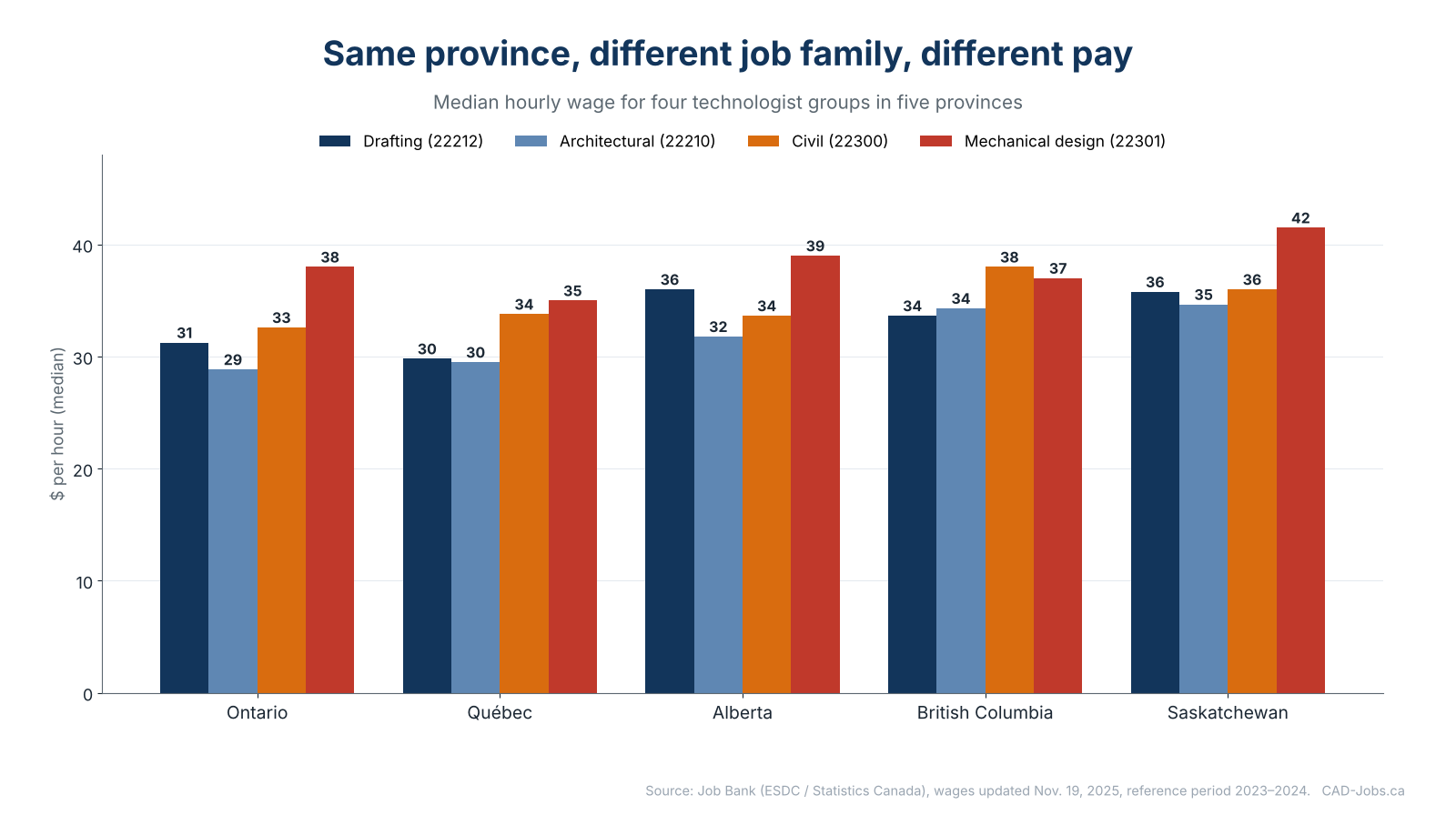
The same diploma can lead to different occupations, and different pay. Here are the medians of four technologist families in five provinces.
| Province | Drafting (22212) | Architectural (22210) | Civil (22300) | Mechanical design (22301) |
|---|---|---|---|---|
| Ontario | $31.25 | $28.85 | $32.60 | $38.00 |
| Québec | $29.81 | $29.50 | $33.79 | $35.00 |
| Alberta | $36.00 | $31.79 | $33.65 | $39.00 |
| British Columbia | $33.65 | $34.31 | $38.00 | $37.00 |
| Saskatchewan | $35.78 | $34.66 | $36.00 | $41.50 |
Median hourly wages. Job Bank, release updated November 19, 2025 (reference period 2023–2024). Some provincial figures are model-based estimates, for example Saskatchewan for mechanical design.
How I read it:
- Mechanical design technologists lead in four of the five provinces shown, from $35.00 in Québec to $41.50 in Saskatchewan. British Columbia is the exception, where civil technologists ($38.00) are slightly ahead of mechanical design ($37.00). Industrial and energy demand supports this group.
- Civil engineering technologists are strong in the West. British Columbia ($38.00) and Saskatchewan ($36.00) have the highest civil medians in this comparison. Large infrastructure and resource projects have been a continuous driver.
- Architectural technologists are the most modest of the four in most provinces, particularly in Ontario ($28.85) and Québec ($29.50). Architectural work depends strongly on construction cycles and, in my experience, on how much fee the client is willing to pay for documentation.
- Saskatchewan is the standout. It has the highest median for architectural and mechanical design, and the second-highest for drafting and civil, among the five provinces shown.
If you are still choosing a program or a specialization, use these numbers as one factor only. Interest, aptitude and the local job market matter more than a $3 difference in median. For detailed comparisons, see Architectural, Civil and Structural Drafter Salaries in Canada and Mechanical Designer and SolidWorks Salaries in Canada.
What Employers Actually Pay a Technologist For
When I approved offers, I was not paying for a title. I was paying for a bundle of capabilities, and the more of them you had, the higher you landed in the range.
1. Reading intent, not just markups. A technician draws what is marked. A technologist understands why it is marked and spots when it is wrong. That alone prevents costly revisions, and it is the first thing I looked for in interviews.
2. Quantities and specifications. Preparing material take-offs, schedules and technical specifications is a skill most drafters never get to practice. Those who can do it become valuable fast.
3. Coordination between disciplines. Knowing how structural, mechanical and electrical affect each other, and being willing to pick up the phone before the conflict arrives on the drawing.
4. Checking and mentoring. Reviewing someone else’s drawings, giving constructive feedback and teaching templates and standards. In my departments, this was the clearest dividing line between “intermediate” and “senior”.
5. Client and contractor contact. Answering questions from a site superintendent or a client’s representative with a clear, confident answer.
6. Software depth. Not “I have used Revit”, but “I can build and maintain families, manage worksets and fix a broken model”. The same applies to Civil 3D, Inventor and SolidWorks.
7. Designation. More on that below.
Professional Designations and Pay
A professional designation is a formal recognition that you have met a standard of education and experience, usually granted by a provincial association. Common titles include C.Tech. (Certified Technician), C.E.T. (Certified Engineering Technologist) and AScT (Applied Science Technologist), depending on the province. In Québec, regulated professional technologists belong to the Ordre des technologues professionnels du Québec.
What I can say with confidence:
- WorkBC notes that certification through provincial associations may be required by employers for these roles.
- In some provinces, using a particular title legally requires membership in the regulating body. For example, in its profile for architectural technologists, WorkBC notes that in Québec, membership in the regulatory body for professional technologists is required to use the title “Professional Technologist”.
- In my experience, a designation matters most at three moments: when you are being considered for a senior or lead role, when a project requires certified signatures, and when a client or public agency wants a certified professional on the team.
What I cannot tell you is a precise dollar value for a designation, because there is no official dataset that isolates it. Anyone who gives you a fixed premium is guessing. My practical advice is this: pursue a designation if your path leads to senior technologist or lead roles, and treat the first raise it brings as a bonus, not a promise. I cover the process in Technologist Certification in Canada: C.Tech., C.E.T., AScT and Provincial Associations Explained, and the broader picture in Which CAD, BIM and GIS Certifications Actually Help You Get Hired?
The Career Ladder and Where the Money Moves
Titles vary from firm to firm, but the steps are consistent, and so is the pay logic.
Junior technician or technologist. Works under supervision. Pay near the lower part of the provincial range. Your job is to become fast, accurate and reliable on defined tasks.
Intermediate technologist. Works from sketches and calculations, manages own deliverables. Pay near the provincial median. This is where most people spend the longest time.
Senior technologist. Checks, mentors, coordinates and manages small packages. Pay in the upper part of the range.
Lead, design coordinator or supervisor. Runs a team or a discipline, interacts with clients and engineers. Pay moves toward the 90th percentile and beyond.
Québec’s occupational profile describes the same path: with experience, workers move to senior or supervisory positions, and with additional training or experience there is mobility toward related fields such as mechanical, electrical or civil engineering. For a real-world view of how steep that ladder is, see the Alberta experience data in CAD Drafter Salary in Canada (2026): By Province, Experience and Industry, and for the full progression, From Drafter to Senior Designer to Manager: The CAD Career Progression Guide.
Why Billing Rates Matter to Your Raise
A point that surprises many technologists: in a consulting office, your salary is only part of what the firm charges for your time. In my experience, the rate billed to the client for a technologist’s hour is often two and a half to three times the hourly cost of the salary, because it has to cover overhead, software, supervision, benefits and profit. These are rules of thumb, not a standard.
Why does that matter to you? Because your value to the firm depends on your utilization, the share of your hours that can be billed. A technologist who consistently delivers billable work on time, and needs little correction, is easier to promote and easier to defend in a budget meeting. When you ask for a raise, bring evidence of billable contribution and quality. It speaks the language that decision-makers use.
Benefits: The Part Not in the Hourly Wage
Job Bank reports the share of workers who receive at least one non-wage benefit: 93.7% for drafting technologists and technicians, 90.7% for civil engineering technologists and 94.3% for mechanical engineering technologists in the national figures.
Those benefits can include employer pension plans, dental, medical and life insurance, paid leave and sick days, and employer contributions to public pensions and insurance programs. In my offers, I also looked at overtime policy, professional dues, a training budget and flexibility. A technologist who compares only the hourly rate is leaving money on the table. Use the checklist in How to Evaluate a CAD Job Offer: Salary, Benefits, Overtime and Total Compensation.
How to Position Yourself and Ask for More
Here is the method I coach people to use.
- Choose the right family. Are you drafting (NOC 22212), civil (22300), mechanical design (22301) or architectural (22210)? Use the table above.
- Pick your province’s median and your province’s high. Your target should sit between them if you have the skills of a senior technologist.
- List what you do beyond drawing. Checking, quantities, specifications, coordination, client contact, standards.
- Show the designation or the plan for it. Even a documented path to certification helps.
- Ask for a number with a reason. “The provincial median for civil technologists is $32.60, and I check other people’s work and lead two projects” is a stronger sentence than “I think I deserve more”.
For scripts and the negotiation process, read How to Negotiate a CAD Salary or Raise in Canada: Data, Scripts and Strategy.
Mistakes I See Technicians and Technologists Make
- Staying a technician in a technologist’s job. If you already check others’ work and nobody has updated your title or pay, that is a conversation to have, with evidence.
- Collecting software certificates but no responsibility. Skills matter, but promotions follow responsibility.
- Never looking outside. People who change firms every few years often earn more than those who wait for annual increases. Loyalty is valuable, but it should not be free.
- Ignoring the province. A move from Prince Edward Island to Alberta can be worth more than three years of raises.
- Treating the national median as a personal target. It is a reference point, not a verdict.
Frequently Asked Questions
Do CAD technicians and drafting technologists earn the same? In government data they share one wage line (NOC 22212). In practice, technologists with more responsibility tend to be paid in the upper half of the range.
What is the national median salary for a CAD technician? Job Bank’s median for drafting technologists and technicians is $31.79 an hour, about $66,100 a year at 2,080 hours.
Which technologist family pays most? In the national data, mechanical design technologists have the highest median of the four families shown here ($35.00), followed by civil ($33.89), drafting ($31.79) and architectural ($30.10).
Do I need a designation to get paid more? Not always, but it helps for senior and lead roles, and it is required for certain titles and signatures. See the certification guide linked above.
Is a diploma enough? For most technician and technologist roles, yes. If you aim to become a licensed engineer later, read From Technologist to Engineer: Pathways, Bridging Programs and Trade-Offs in Canada.
How do I move from technician to technologist? Take on checking, specifications and coordination, document your results and begin the designation process. The full path is in How to Become a CAD Drafter in Canada: Step-by-Step Roadmap.
Sources
- Job Bank: Design and drafting technologist wages (NOC 22212)
- Job Bank: Architectural technologist wages (NOC 22210)
- Job Bank: Civil engineering technologist wages (NOC 22300)
- Job Bank: Mechanical engineering design technologist wages (NOC 22301)
- Job Bank: How wages are determined
- WorkBC career profile: Drafting technologists and technicians
- Québec occupational profile: Drafting technologists and technicians
Wages describe 2023–2024. Check the live Job Bank pages for newer releases.
A technician who knows what a technologist does, and a technologist who knows what employers pay for, can plan a career instead of waiting for one. Start by deciding which rung you are on, and which one you want next.