



On a mixed-use building I once managed, three drafters worked side by side in the same open-plan office. One produced architectural plans, one prepared the site and servicing drawings and one detailed the structural steel. At the end of the project, the three of them compared pay stubs over a coffee, which is something I do not recommend, because I was the one who had to explain the differences on Monday morning.
The differences were real, and they were not random. They came from what each discipline requires, how each is priced by the market and where each person sat on their own career ladder. Architectural, civil and structural drafting look similar from the outside: lines, layers, sheets, revisions. Inside the profession they are three different worlds, with different software, different clients, different cycles and different salary patterns.
This guide shows you what the official data says about each of the three, where the data runs out, and how to think about your own pay depending on the discipline you work in.
The Short Answer
Job Bank files these disciplines in neighbouring occupation groups. The figures below come from the release updated on November 19, 2025 and reflect wages paid in 2023–2024.
| Occupation group | Low (10th pct) | Median | High (90th pct) | Median per year |
|---|---|---|---|---|
| Architectural technologists and technicians (NOC 22210) | $21.00 | $30.10 | $50.68 | $62,600 |
| Drafting technologists and technicians, including structural steel drafters and detailers (NOC 22212) | $21.50 | $31.79 | $48.38 | $66,100 |
| Civil engineering technologists and technicians (NOC 22300) | $22.00 | $33.89 | $51.10 | $70,500 |
- Architectural technologists and technicians (NOC 22210) have a national median of $30.10 an hour, about $62,600 a year.
- Civil engineering technologists and technicians (NOC 22300) have a national median of $33.89 an hour, about $70,500 a year.
- Structural drafters do not have a separate line. Structural steel drafters and detailers are listed as job titles inside the general drafting group (NOC 22212), whose median is $31.79 an hour, about $66,100 a year. Structural engineering technologists are generally counted with civil technologists.
Annual figures use 2,080 hours and are rounded to the nearest $100. For how Job Bank builds these numbers and how to read the low and high columns, see CAD, BIM and Drafting Salaries in Canada: The Complete 2026 Data Guide.
The headline: civil sits at the top, general drafting (which includes structural) in the middle, architectural at the bottom. The gap between civil and architectural is $3.79 an hour at the median, around $7,900 a year. That gap, however, is smaller than the spread inside each group, so it is not a reason by itself to change discipline.
What Each Discipline Actually Does
Architectural drafting and technology
You produce the documents that turn an architect’s design into a buildable project: plans, elevations, sections, details, schedules, specifications. Technologists often handle building code analysis, coordinate with consultants and manage drawing sets through permit and construction. The core tools are Revit and AutoCAD, with ArchiCAD in some offices. Work follows the building cycle: busy when construction is strong, tight when financing slows.
Civil drafting and civil technology
You prepare site plans, grading, roads, water and sewer, stormwater, utilities and survey-based drawings. Civil 3D is the key tool, supported by AutoCAD and increasingly by BIM workflows for infrastructure. Work follows land development, municipal programs and large public projects. Civil technologists commonly do design calculations, material quantities and inspection support in addition to drawing.
Structural drafting and detailing
You prepare structural drawings for buildings and infrastructure: framing plans, foundations, connections, reinforcement. There are two quite different worlds here. In consulting engineering firms, structural drafters work with Revit, AutoCAD and sometimes analysis tools, producing design drawings for engineers. In fabrication shops and detailing firms, steel detailers and rebar detailers produce shop drawings for manufacturers using tools such as Tekla Structures or Advance Steel, where precision and fabrication knowledge are paramount.
Architectural Technologist Salaries by Province
| Province | Low (10th pct) | Median | High (90th pct) | Median per year |
|---|---|---|---|---|
| Canada | $21.00 | $30.10 | $50.68 | $62,600 |
| Saskatchewan (est.) | $22.77 | $34.66 | $56.27 | $72,100 |
| British Columbia | $24.50 | $34.31 | $45.39 | $71,400 |
| New Brunswick (est.) | $20.69 | $32.56 | $45.89 | $67,700 |
| Newfoundland and Labrador (est.) | $24.33 | $31.89 | $39.51 | $66,300 |
| Alberta | $24.00 | $31.79 | $51.28 | $66,100 |
| Nova Scotia (est.) | $21.86 | $31.49 | $44.86 | $65,500 |
| Manitoba (est.) | $23.75 | $31.34 | $47.00 | $65,200 |
| Québec | $20.00 | $29.50 | $56.00 | $61,400 |
| Ontario | $21.00 | $28.85 | $43.27 | $60,000 |
(est.) marks figures that come from Statistics Canada’s model-based Small Area Estimation instead of a direct survey count. British Columbia’s figure is based on Employment Insurance survey data. Annual figures: median × 2,080 hours, rounded to the nearest $100.
A few points to notice.
- British Columbia ($34.31) and Saskatchewan ($34.66) are the highest medians for architectural technologists.
- New Brunswick ($32.56), Newfoundland and Labrador ($31.89), Alberta ($31.79), Nova Scotia ($31.49) and Manitoba ($31.34) all sit above the national median of $30.10.
- Ontario ($28.85) is the lowest of the provinces published, and its high figure ($43.27) is also lower than most. Ontario is the largest market and, as in many professions, size brings competition on salary.
- Québec ($29.50) has the widest spread, from $20.00 at the 10th percentile to $56.00 at the 90th, which points to a group of very well-paid senior people at the top of the scale.
- Prince Edward Island, the Northwest Territories, Nunavut and Yukon are not published for this occupation.
Several of these figures come from model-based estimates rather than direct survey counts, in particular in Manitoba, New Brunswick, Newfoundland and Labrador, Nova Scotia and Saskatchewan. Treat them as reliable indicators, not exact measurements.
Regional detail.
| Region | Province | Low (10th pct) | Median | High (90th pct) | Median per year |
|---|---|---|---|---|---|
| Toronto Region | ON | $22.00 | $30.60 | $40.80 | $63,600 |
| Ottawa Region | ON | $22.00 | $28.41 | $38.25 | $59,100 |
| Kitchener–Waterloo–Barrie | ON | $21.00 | $28.85 | $43.27 | $60,000 |
| Hamilton–Niagara Peninsula | ON | $21.00 | $28.85 | $43.27 | $60,000 |
| Montréal Region | QC | $20.32 | $30.34 | $46.44 | $63,100 |
| Moncton–Richibucto | NB | $24.55 | $33.54 | $43.76 | $69,800 |
| Saskatoon–Biggar | SK | $23.33 | $38.45 | $50.80 | $80,000 |
Regional figures come from Job Bank, and several of them are model-based estimates. Annual figures: median × 2,080 hours, rounded to the nearest $100.
Two things I would underline. The Toronto Region median ($30.60) is only a little above Ontario’s ($28.85), which is a modest premium for the country’s most expensive major city. And Saskatoon ($38.45) is markedly above the provincial figure, which tells you what a strong local market can do.
The Alberta experience view. Alberta’s 2023 Wage and Salary Survey reports wages at three stages for architectural technologists and technicians: a median starting wage of $25.64, a typical (overall) median of $36.78 and a top-of-scale median of $50.79. The top 5% at the high end reach $84.13 an hour. This is some of the best evidence we have that architectural technology pays progressively: the bottom of the ladder looks modest, the top looks very different.
British Columbia detail. WorkBC reports annual earnings of $70,036 for architectural technologists in the province and forecasts about 740 job openings between 2025 and 2035.
Québec note. In Québec, membership in the regulatory body for professional technologists is required to use the title “Professional Technologist” (WorkBC profile).
Civil Engineering Technologist Salaries by Province
| Province or territory | Low (10th pct) | Median | High (90th pct) | Median per year |
|---|---|---|---|---|
| Canada | $22.00 | $33.89 | $51.10 | $70,500 |
| British Columbia | $23.00 | $38.00 | $50.00 | $79,000 |
| Yukon (est.) | $27.82 | $36.74 | $49.11 | $76,400 |
| Saskatchewan | $23.08 | $36.00 | $57.62 | $74,900 |
| Prince Edward Island (est.) | $26.95 | $33.97 | $43.33 | $70,700 |
| Québec | $21.00 | $33.79 | $51.28 | $70,300 |
| Alberta | $22.00 | $33.65 | $53.84 | $70,000 |
| Nova Scotia (est.) | $24.67 | $33.12 | $45.48 | $68,900 |
| Ontario | $22.00 | $32.60 | $51.00 | $67,800 |
| Manitoba | $21.00 | $29.81 | $43.59 | $62,000 |
| New Brunswick | $23.08 | $29.57 | $41.54 | $61,500 |
| Newfoundland and Labrador | $21.00 | $29.00 | $54.00 | $60,300 |
(est.) marks figures that come from Statistics Canada’s model-based Small Area Estimation instead of a direct survey count. Annual figures: median × 2,080 hours, rounded to the nearest $100.
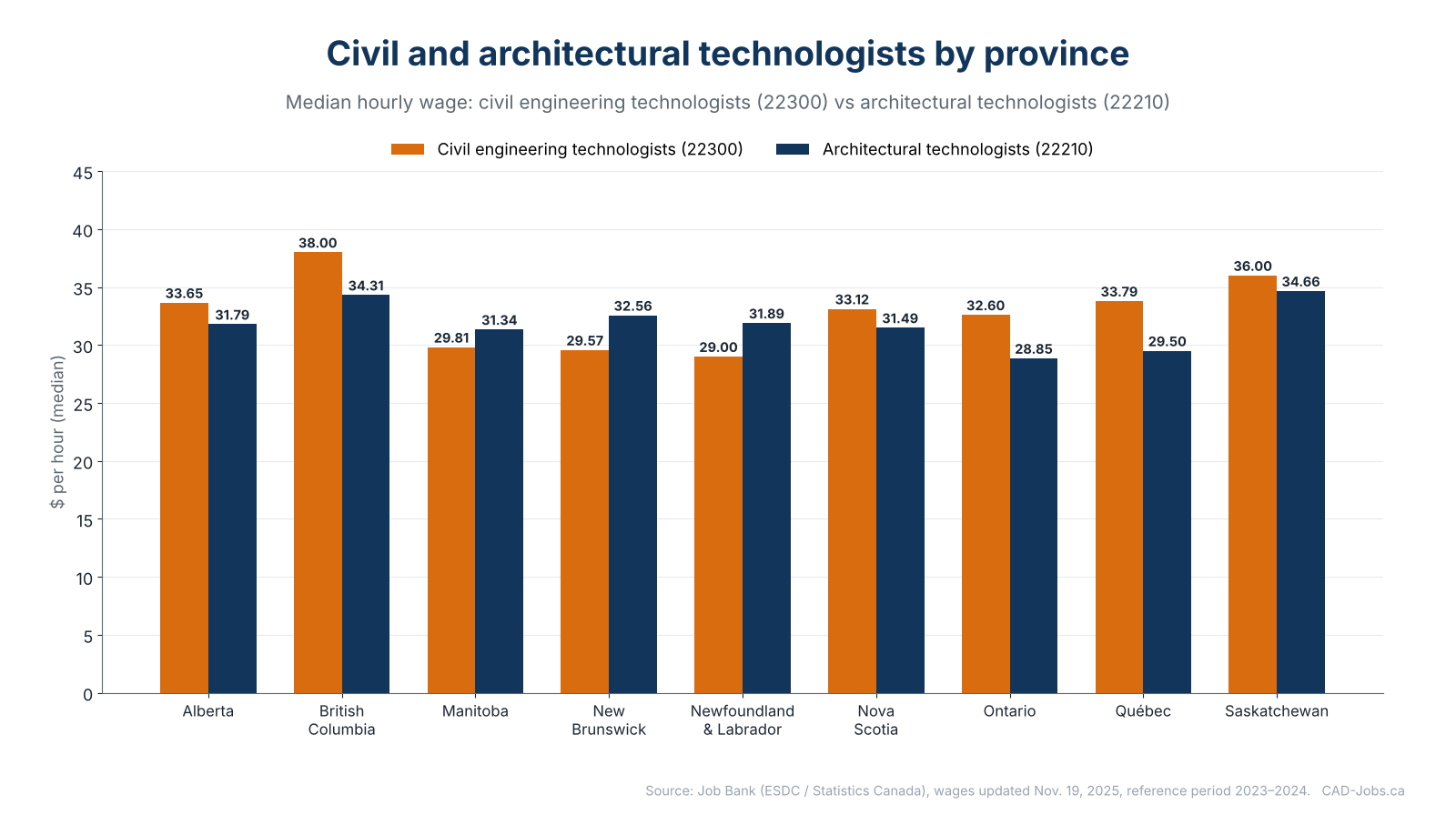
What stands out:
- British Columbia ($38.00), the Yukon ($36.74) and Saskatchewan ($36.00) lead. Large infrastructure, resource and public works programs sustain demand.
- Civil technologists out-earn architectural technologists in six of the nine provinces in the chart (Alberta, British Columbia, Nova Scotia, Ontario, Québec and Saskatchewan). Architectural technologists are ahead in Manitoba, New Brunswick and Newfoundland and Labrador.
- The ranges are very wide. In Newfoundland and Labrador the 10th and 90th percentiles are $21.00 and $54.00; in Saskatchewan, $23.08 and $57.62.
- Manitoba, New Brunswick and Newfoundland and Labrador are the lowest at $29.81, $29.57 and $29.00, roughly $4 to $5 below the national median of $33.89.
Again, several of these provincial figures (Nova Scotia, Prince Edward Island, the Yukon) are model-based estimates.
Regional detail.
| Region | Province | Low (10th pct) | Median | High (90th pct) | Median per year |
|---|---|---|---|---|---|
| Vancouver Island and Coast | BC | $27.85 | $40.13 | $51.79 | $83,500 |
| Lower Mainland–Southwest | BC | $22.00 | $38.00 | $50.00 | $79,000 |
| Northwest Region | ON | $24.48 | $35.19 | $46.75 | $73,200 |
| Montréal Region | QC | $21.00 | $33.79 | $51.28 | $70,300 |
| Calgary, Edmonton and Red Deer regions | AB | $22.00 | $33.65 | $53.84 | $70,000 |
| Moncton–Richibucto | NB | $23.08 | $29.57 | $41.54 | $61,500 |
Regional figures come from Job Bank, and several of them are model-based estimates. Annual figures: median × 2,080 hours, rounded to the nearest $100.
The Vancouver Island and Coast Region ($40.13) is the highest figure I found for civil technologists at regional level, above the Lower Mainland ($38.00). In Alberta, Job Bank shows the same figure for Calgary, Edmonton and Red Deer as for the province ($33.65), which reflects the limited sample, not a perfectly even market.
Structural Drafters and Detailers: What the Data Can and Cannot Say
This is the discipline with the thinnest official data, and I want to be completely honest about it.
What we know. Structural steel drafters and detailers are listed as job titles in the general drafting group (NOC 22212). That means their wages are inside the drafting figures: national median $31.79, 10th percentile $21.50, 90th percentile $48.38. By province, the provincial medians in my guide CAD Drafter Salary in Canada (2026): By Province, Experience and Industry apply to you as a reference point.
What we do not know. There is no official wage line that isolates structural drafters from general drafters, and none that separates consulting structural drafting from fabrication detailing. Anyone who gives you a precise structural drafter salary is extrapolating.
What my experience says, and please read this as experience and not as a statistic:
- Consulting structural drafters tend to be paid near the drafting median, with progression tied to Revit skills, the ability to read an engineer’s calculations and the capacity to check others’ work.
- Steel detailers who are strong in Tekla Structures or Advance Steel were consistently among the hardest people to hire and could be paid above the general drafting median, because fabrication errors cost real money, and a good detailer prevents them.
- Fabrication shops often pay by the hour with overtime, which can lift total earnings above the base rate.
- Structural engineering technologists, who carry out design checks and calculations in addition to drawing, are generally counted with civil technologists and are paid accordingly.
If structural work attracts you, the best investment is depth in one tool plus knowledge of how things are built. A detailer who has visited a fabrication shop and watched steel being cut understands connections in a way that a person who has only seen drawings never will.
Which Pays More, and Does It Matter?
| Question | Short answer |
|---|---|
| Highest national median | Civil engineering technologists, $33.89 |
| Lowest national median of the three | Architectural technologists, $30.10 |
| Where structural fits | Inside the drafting group, $31.79, depending on role and sector |
| Biggest spread inside one group | Architectural: $21.00 to $50.68 |
| Strongest regions for civil | British Columbia, Saskatchewan, the Yukon |
| Strongest regions for architectural | Saskatchewan, British Columbia |
Does the difference matter? Less than you think. A technologist at the 75th percentile in architecture earns more than a technologist at the 25th percentile in civil. Your performance, scope and province matter more than the discipline label. I would never advise someone to switch disciplines for $3 an hour. I might advise them to change if the work itself does not suit them.
How to decide, from my years of watching people choose:
- If you love design, coordination with architects and the visual side of buildings, architectural technology will keep you motivated, and pay progresses with responsibility.
- If you like systems, land, infrastructure and calculations, civil offers steady demand and a strong path into design and project coordination.
- If you like precision, geometry and seeing your drawings turn into physical steel or concrete, structural drafting and detailing give satisfaction few other roles can match.
For a view across all disciplines, see CAD Specializations Compared: Civil, Architectural, Structural, MEP, Mechanical and GIS.
Benefits and the Rest of the Package
Job Bank reports that 86.7% of architectural technologists and technicians and 90.7% of civil engineering technologists and technicians receive at least one non-wage benefit, compared with 93.7% in the general drafting group. The lower share in architecture is consistent with the many small firms in that field. Pension plans, group insurance and paid leave are not universal, and when you compare offers from small and large firms, the benefits difference can be bigger than the salary difference. See How to Evaluate a CAD Job Offer: Salary, Benefits, Overtime and Total Compensation.
Negotiating by Discipline
Each discipline has its own best arguments.
Architectural. Emphasize your ability to coordinate consultants, manage permit submissions and reduce revisions. Bring evidence of projects delivered on time and your command of Revit standards. Mention any technologist designation or progress toward it.
Civil. Emphasize Civil 3D depth, ability to read survey data and design constraints, experience with municipal submission standards and, if you have it, quantity take-offs and design calculations.
Structural. Emphasize your tool depth (Revit, Tekla, Advance Steel), your accuracy record and your ability to understand connection details and fabrication constraints.
In every case, anchor your number in your province’s median for your occupation group and explain, specifically, why your scope puts you above it. For scripts and tactics, read How to Negotiate a CAD Salary or Raise in Canada: Data, Scripts and Strategy.
Frequently Asked Questions
How much does an architectural technologist make in Canada? The national median is $30.10 an hour, about $62,600 a year at 2,080 hours, with the middle 80% earning between $21.00 and $50.68 an hour (Job Bank, November 2025 release).
How much does a civil engineering technologist make? The national median is $33.89 an hour, about $70,500 a year, with a range of $22.00 to $51.10 an hour.
How much does a structural drafter make? There is no separate national wage. Structural drafters sit in the general drafting group, with a median of $31.79 an hour, and individual pay depends on tools, sector and responsibility.
Which discipline is easiest to get into? Architectural and civil drafting have the largest numbers of entry-level positions. See How to Get Your First CAD Job in Canada: Entry-Level Roadmap.
Do I need a designation? It is often valued for senior roles and sometimes required for certain titles. Read Technologist Certification in Canada: C.Tech., C.E.T., AScT and Provincial Associations Explained.
Can I move between these disciplines? Yes. Many drafters change after a few years, usually by adding a tool or a certificate. It helps to start with the guide CAD Drafter vs CAD Technician vs Designer vs Drafting Technologist: The Complete Comparison.
Sources
- Job Bank: Architectural technologist wages (NOC 22210)
- Job Bank: Civil engineering technologist wages (NOC 22300)
- Job Bank: Design and drafting technologist wages (NOC 22212)
- Job Bank: How wages are determined
- Alberta ALIS: Architectural technologists and technicians (2023 Alberta Wage and Salary Survey)
- WorkBC career profile: Architectural technologists and technicians
- WorkBC career profile: Drafting technologists and technicians
Wages describe 2023–2024. Check the live Job Bank pages for newer releases.
Pick the discipline that you would still enjoy on a Friday afternoon with a deadline on Monday. The pay will follow the person who is good at it.